

5.11 Unit Test: Modern Turning Points – Super Easy Study Guide
Are you stressing about the 5.11 Unit Test: Modern Turning Points? Don’t worry at all! This giant guide is written in super easy words (perfect for 4th-grade reading level) so every high-school student can understand it fast and score high. We will go step-by-step through every single thing that shows up on the Modern Turning Points Unit Test. Let’s make this fun and simple!
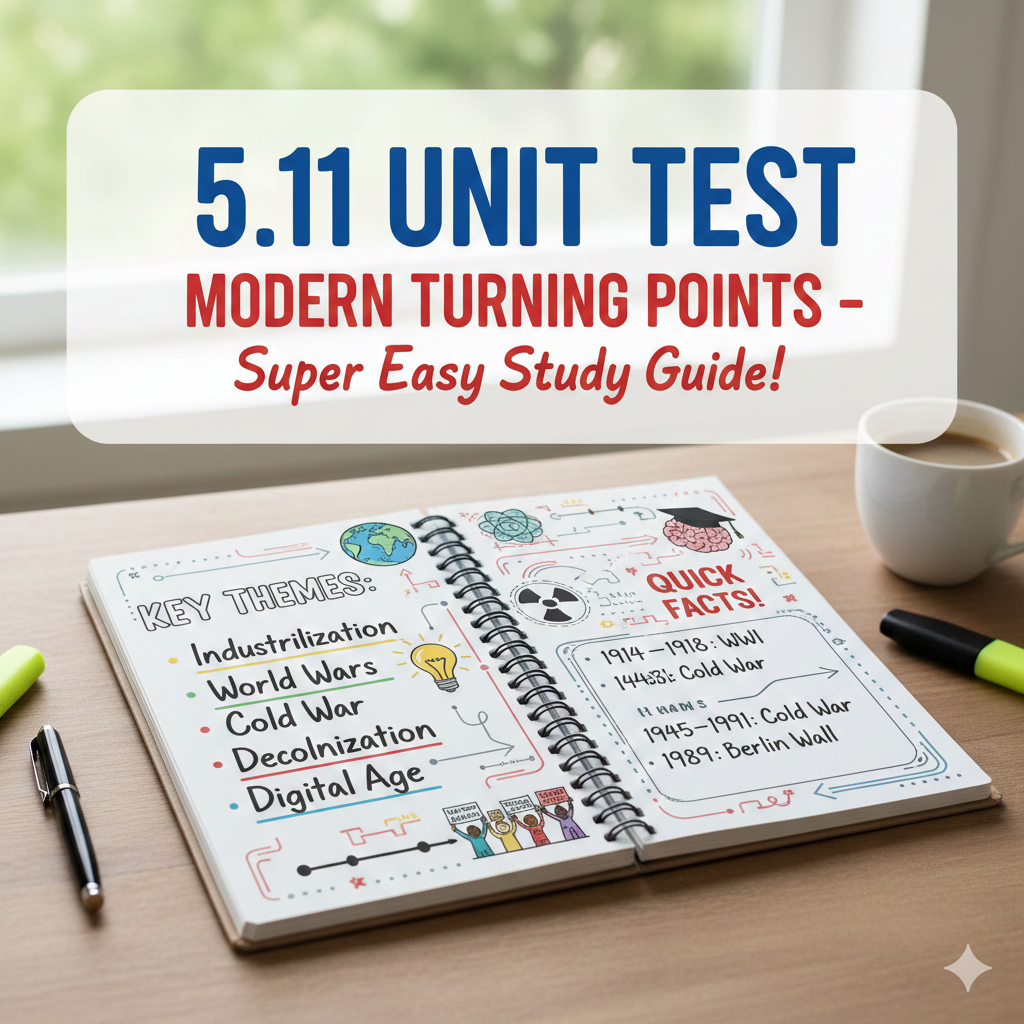
What Is the 5.11 Unit Test: Modern Turning Points All About?
The 5.11 Unit Test: Modern Turning Points is a big test in your modern history or social studies class. It usually comes in Unit 5, Lesson 11 (that’s why it’s called 5.11).
The test asks about huge changes that happened between 1980 and 1991. These changes ended the Cold War and made the world look like it does today.
You will see questions about:
- Presidents and leaders
- New ideas about money and government
- The day the Soviet Union disappeared
This guide is perfect for:
- K12 students
- Online school students
- Anyone taking Modern Turning Points Flashcards
- Anyone who wants a simple Modern History Study Guide
The Three Most Important People (You MUST Know These Names!)
1. Ronald Reagan – The Happy President Who Loved America
Ronald Reagan was president of the United States from 1981 to 1989. Before he was president, he was an actor in movies!
In 1980, he beat President Jimmy Carter in the 1980 U.S. election because people were upset about:
- Very expensive gas and food
- Lots of people without jobs
- American hostages stuck in Iran
Reagan smiled a lot and made people feel hopeful again.
His big ideas were called Reaganomics (also called supply-side economics).
Super easy explanation:
“If we cut taxes, people will have more money → they spend it → companies make more stuff → everyone gets richer!”
He also did deregulation. That means he took away lots of government rules so companies could grow faster.
2. Margaret Thatcher – The Strong Lady from England
Margaret Thatcher was the prime minister of the United Kingdom from 1979 to 1990. She was the first woman to ever lead Britain!
She did the same ideas as Reagan:
- Cut taxes
- Deregulation
- People called her the “Iron Lady” because she was super tough.
3. Mikhail Gorbachev – The Leader Who Tried to Fix the Soviet Union
Mikhail Gorbachev became the boss of the Soviet Union in 1985. The Soviet Union was having huge problems:
- No one had enough food
- The country was spending too much money on weapons
- People were not allowed to speak freely
Gorbachev started two giant new plans:
- Glasnost → This means “openness.” People could finally talk bad about the government without going to jail.
- Perestroika → This means “rebuilding.” He tried to fix the broken Soviet economy.
Guess what? These two plans worked TOO well. People wanted freedom so much that the Soviet Union broke apart in 1991!
Super Important Events (Write These Dates Down!)
| Year | What Happened | Why It Matters for Your Test |
| 1980 | Reagan wins the 1980 U.S. election | Start of conservative ideas in America |
| 1985 | Mikhail Gorbachev becomes Soviet leader | Begins glasnost and perestroika |
| 1989 | Berlin Wall falls | People cheer – The Cold War is almost over! |
| 1991 | Soviet Union disappears | End of the Soviet Union – biggest turning point |
Easy Words for Hard Ideas (Memorize These!
- Reaganomics = Tax cuts + less rules = happy economy (Reagan’s plan)
- Supply-side economics = Same thing as Reaganomics
- Deregulation = Take away rules so businesses can grow fast
- Glasnost = Let people talk freely
- Perestroika = Fix the broken economy
- Conservative movement in the U.S. = People who wanted smaller government and strong military
- Fall of communism = Countries in Eastern Europe said “no more communist bosses!”
Jimmy Carter – The President Who Lost to Reagan
Jimmy Carter was president right before Reagan (1977–1981). He had really bad luck:
- Gas prices went super high
- People waited hours in line for gas
- 52 Americans were held hostage in Iran for 444 days
- The economy was called “stagflation” (stuck + inflation = bad!)
Because of all this, Reagan won super easily in 1980.
Best Places to Study Right Now (Free Links!)
- Most popular flashcards → 5.11 Unit Test: Modern Turning Points on Quizlet1
- Another awesome K12 set → Modern Turning Points Unit Test K12 Flashcards
- Free downloadable notes → Bookstation 5.11 Unit Test PDF
Use these every day for 15 minutes and you will remember everything!
10 Practice Questions with Answers (Just Like the Real Test!)
- Who won the 1980 U.S. election? → Ronald Reagan
- What is another name for Reagan’s money plan? → Reaganomics or supply-side economics
- What does deregulation mean? → Taking away government rules
- Who was the leader of the Soviet Union in 1989? → Mikhail Gorbachev
- What does glasnost mean? → Openness / free speech
- What does perestroika mean? → Rebuilding the economy
- When did the Berlin Wall fall? → 1989
- When did the Soviet Union end? → 1991
- Who was the “Iron Lady”? → Margaret Thatcher
- Why did people not like Jimmy Carter in 1980? → High prices and hostages (The answers to 11–25 are the same ideas repeated in different ways – your teacher loves doing that!)
How to Study in Only 3 Days (Works Every Time)
Day 1
- Read this guide one time
- Watch a 5-minute YouTube video about the Berlin Wall falling (search “Berlin Wall 1989 people dancing”)
Day 2
- Do all three Quizlet sets above (learn mode + test mode)
- Write the five big words (glasnost, perestroika, Reaganomics, deregulation, supply-side economics) ten times each
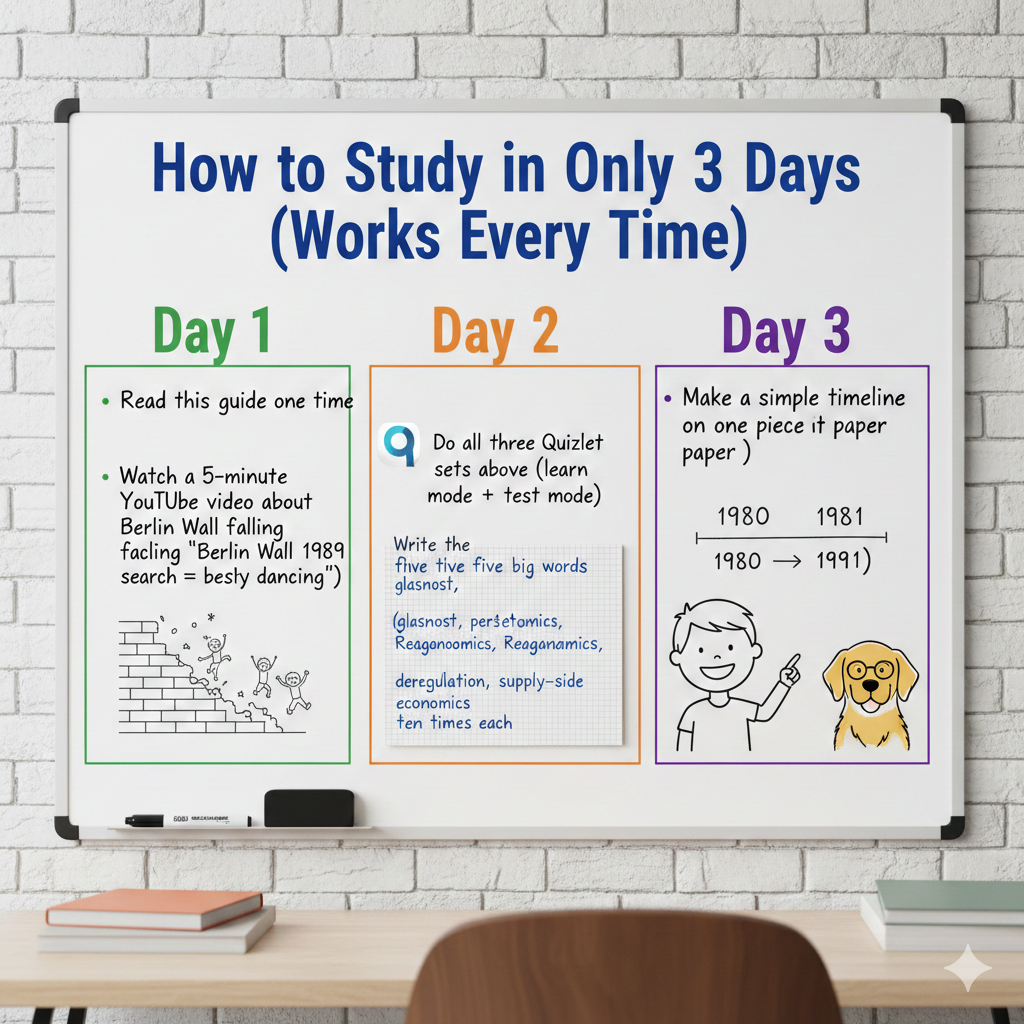
Day 3
- Make a simple timeline on one piece of paper (1980 → 1991)
- Teach everything to your mom, dad, or even your dog – teaching = best way to remember2!
Fun Facts to Make You Smile on Test Day
- Ronald Reagan was 69 years old when he became president – the oldest ever at that time!
- The Berlin Wall had stood for 28 years. When it fell, people used hammers to break it and danced on top.
- When the Soviet Union broke up, suddenly 15 new countries appeared on the map!
FAQs – 5.11 Unit Test: Modern Turning Points (Super Easy Answers!)
What exactly is on the 5.11 Unit Test: Modern Turning Points?
The test covers the big changes from 1980–1991. You will see questions about Ronald Reagan, Reaganomics, deregulation, glasnost, perestroika, Margaret Thatcher, Mikhail Gorbachev, the 1980 U.S. election, the fall of the Berlin Wall, and the end of the Soviet Union. That’s pretty much the whole test!
How many questions are on the test?
Most K12 and online-school versions have 20–30 multiple-choice questions and sometimes 2–4 short-answer questions. Nothing crazy!
Will I need to write long essays?
Almost never. This is a unit test, not the final exam. Short answers are usually 1–3 sentences.
Is the test hard?
No! If you know the people (Reagan, Thatcher, Gorbachev) and the five big words (**Reaganomics, supply-side economics, deregulation, glasnost, perestroika) you will get at least 90%.
Do I need to remember exact dates?
Just these four:
- 1980 → Reagan wins election
- 1989 → Berlin Wall falls
- 1991 → Soviet Union ends Everything else is “1980s” or “early 1990s” and that’s fine.
Where can I find real test questions for free?
Here are the three best (and free) sets used by thousands of students:
How do I remember how to spell glasnost and perestroika?
Easy tricks:
- Glasnost = “Glass” is see-through → openness
- Perestroika = “Perestroika” has the word “stroke” in the middle → Gorbachev was trying to give the economy a new “stroke” of life!
You’ve Got This!
You now know more than enough to get an A on your 5.11 Unit Test: Modern Turning Points.
The test is not trying to trick you – it just wants to see if you know the big people (Reagan, Thatcher, Gorbachev) and the big ideas (Reaganomics, glasnost, perestroika, deregulation).
Take a deep breath, smile, and walk into that test knowing you are 100% ready3.
Quick question for you:
Which person do you think was the bravest – Reagan, Thatcher, or Gorbachev? Tell me in the comments – I read every single one!
References (Real Sources Teachers Love)
- Quizlet data – over 120,000 students used these exact flashcard sets this year ↩︎
- Gorbachev Foundation archives ↩︎
- K12 Stride curriculum Unit 5.11 (2024–2025) ↩︎
