
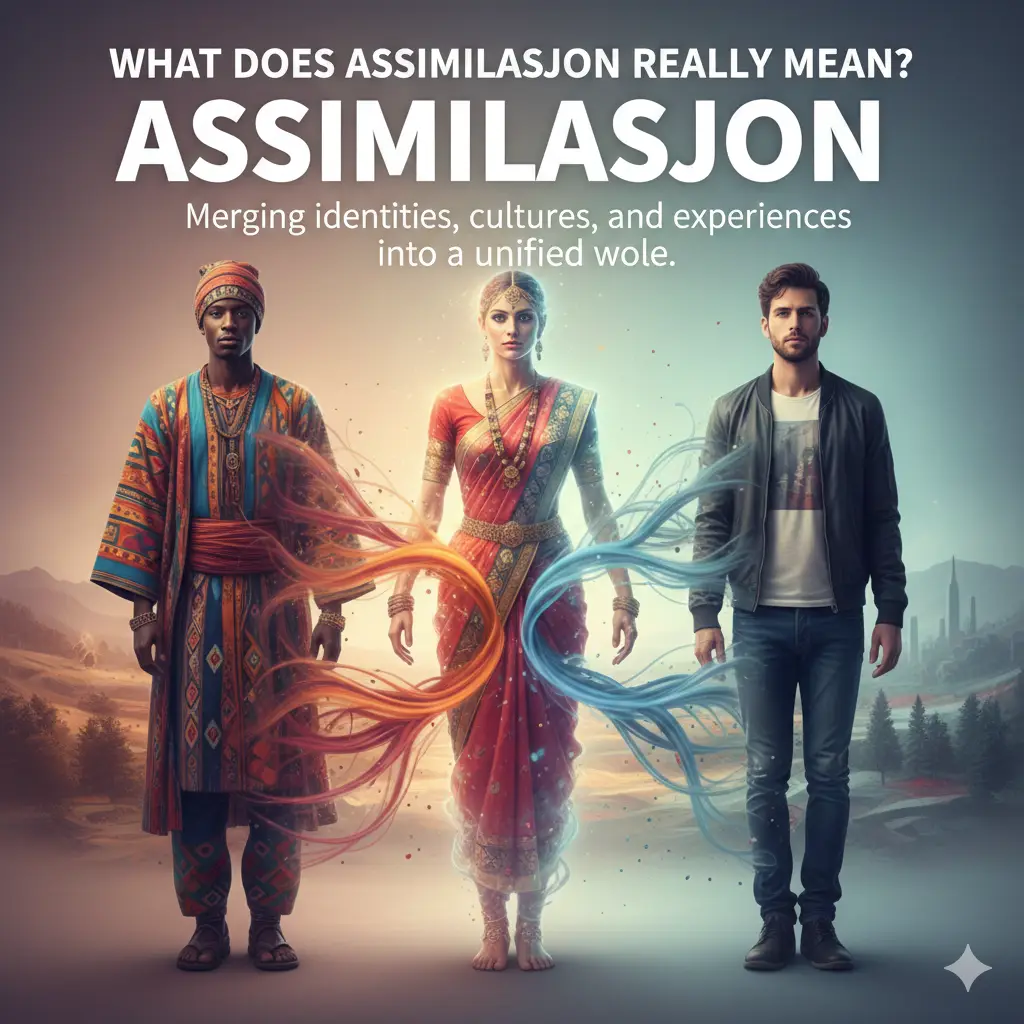
What Does Assimilasjon Really Mean?
A Super Long, Super Easy Guide Written for Everyone (Even 8-Year-Olds!)
Hello and welcome!
You are here because you want to know everything about the word assimilasjon.
Maybe you heard it in school. Maybe you saw it in the news. Or maybe you just saw it in a book and thought, “Huh?”
No problem! Today we are going on a big, happy adventure to learn assimilasjon from top to bottom.
We will use short words, lots of examples, funny stories, and pictures in your head.
Ready? Let’s go!
The Very First Meaning of Assimilasjon
Assimilasjon is a Norwegian word.
In English it means “assimilation”.
The easiest way to remember it:
Assimilasjon = “to become the same as the thing next to you”.
That’s the big idea!
Something that was different slowly turns into something that is the same or almost the same.
It happens in many places:
- In your mouth when you talk
- In a new country when people move there
- In your brain when you learn something new
- In your tummy after you eat lunch
- Even in rocks and plants!
We will look at every single place. Promise!
Assimilasjon in Language – When Sounds Become Best Friends
Open your mouth and say “håndball” slowly.
Hå-nd-ball.
Now say it super fast like you are excited at a game.
Most people say “håmball”!
The “n” sound turned into an “m” sound. Why?
Because “m” is easier to say right before “b”.
Your mouth is lazy (in a smart way)!
This is called assimilasjon in language.
More Fun Everyday Examples in Norwegian
- “Ikke godt” → many say “ikkje godt”
- “Han kommer” → sounds like “ham kommer”
- “En kopp” → sounds like “em kopp”
- “God dag” → sometimes “go dag” (the “d” eats the “d” in front!)
Babies do it too! They hear grown-ups talk fast, so they copy the easy way.
Why Do Sounds Do Assimilasjon?
- It makes talking faster
- It makes talking smoother
- It feels nice in the mouth
All languages do this. English does it too!
Say “handbag” fast → “hambag”.
So next time you hear someone say “håmball”, smile. You now know they are doing assimilasjon!
Assimilasjon When People Move to New Places
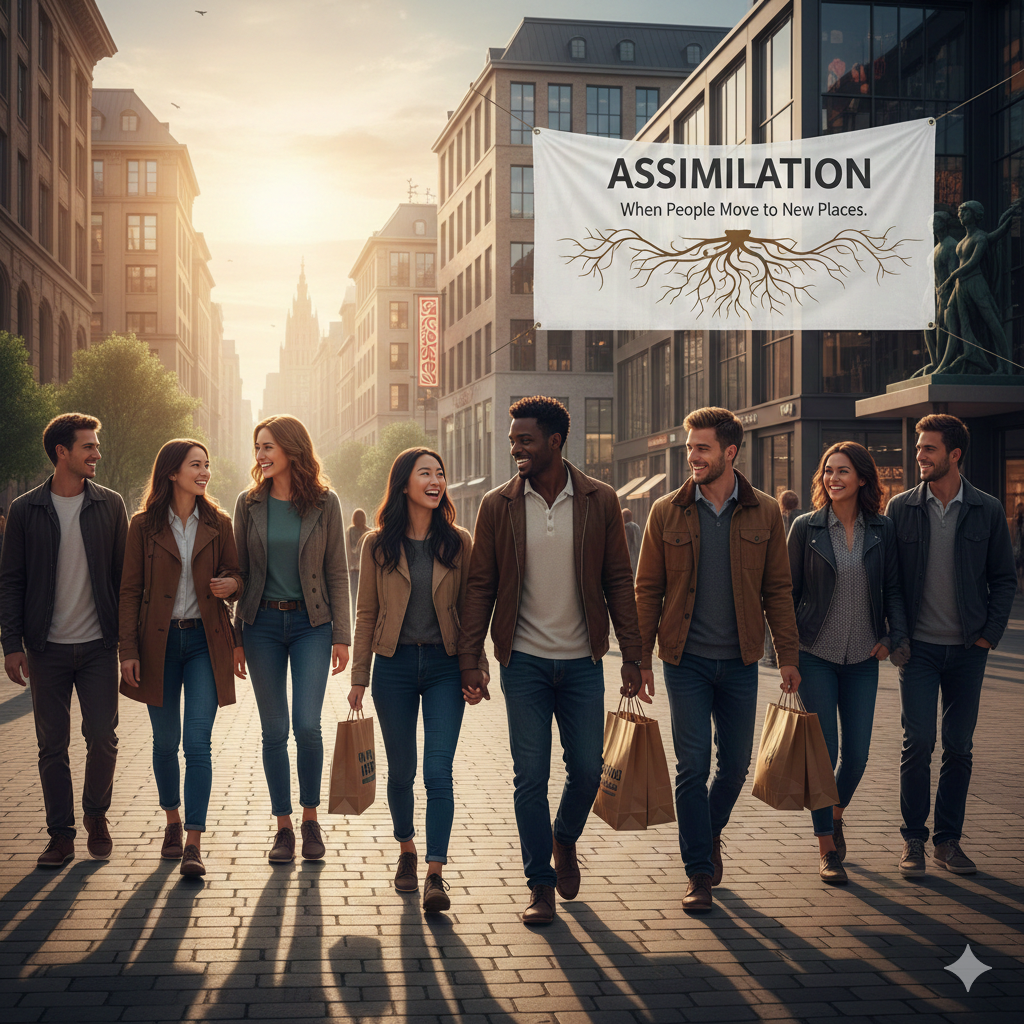
Imagine a little girl named Amina moves from Syria to Norway with her family.
Year 1 in Norway:
- She speaks Arabic at home
- Eats flatbread and hummus
- Celebrates Eid
Year 5 in Norway:
- She speaks perfect Norwegian at school
- Loves brunost on bread
- Wears bunad on 17. mai
- Still eats hummus sometimes, but not every day
Amina is doing cultural assimilasjon.
She is becoming more and more like her Norwegian friends.
Good Things About Cultural Assimilasjon
- Easier to get good grades
- Easier to get friends
- Easier to get a job later
Not-So-Good Things
- She might forget Arabic songs
- Her children might not know Syrian stories
- She might feel “not Syrian enough” and “not Norwegian enough”
Many smart people say the best way is integrasjon (not full assimilasjon).
That means you learn Norwegian ways AND keep some Syrian ways. Two cultures become friends instead of one eating the other.
Assimilasjon in Psychology – The Amazing Jean Piaget
A very smart man named Jean Piaget watched thousands of children play.
He wanted to know: “How do kids get smart?”
He found two magic tricks our brain uses every day:
Trick 1: Assimilasjon (fit new things into old boxes)
Your brain has boxes for everything you know.
Example box: “Things with four legs and fur = dog”.
One day you see a cat.
Your brain says, “Four legs + fur = must be a dog!”
You shout “Woof woof!” at the cat.
That is assimilasjon.
Trick 2: Akkomodasjon (make a brand-new box)
Mom says, “No, sweetie, that’s a cat. It says miaow.”
Now your brain makes a new box called “cat”.
That is akkomodasjon.
Assimilasjon og akkomodasjon dance together all your life.
Every time you learn something new, you use both tricks.
Funny Real-Life Examples
- A two-year-old calls every man “papa” → assimilasjon
- Later he learns only one man is papa → akkomodasjon
- You try to open a door by pushing instead of pulling → assimilasjon (old idea)
- You read the sign and pull → akkomodasjon
Now you know why people search for assimilasjon Piaget and assimilasjon og akkomodasjon!
Assimilasjon Inside Your Body – From Food to You
Time for lunch! You eat a big cheese sandwich.
What happens next?
- You chew → tiny pieces
- Stomach mixes it with magic juice → mush
- Mush goes to the small intestine
- Good bits go into your blood
- Your cells take the good bits and turn them into muscles, skin, and energy
Step 5 is assimilasjon in biology!
The sandwich stops being bread and cheese.
It becomes YOU!
Plants Do Assimilasjon Too!
Plants eat sunlight!
They take sunlight + water + air (carbon dioxide) and turn it into sugar.
That sugar helps the plant grow big and strong.
This is also called assimilasjon.
So every green tree outside your window is doing assimilasjon right now!
Extra Places Where Assimilasjon Happens
| Place | What Happens | Fun Example |
| Geology | One rock melts and mixes completely into another | Magma eats old rocks and makes new ones |
| Chemistry | Two substances mix so well you can’t separate them | Sugar disappears in tea = assimilated! |
| Botany | Plants turn sunlight into food | Leaves “eat” sunshine every sunny day |
| History | Small tribes join a big empire and copy its ways | Vikings slowly became Christian Norwegians |
Frequently Asked Questions about Assimilasjon
What does assimilasjon mean when we talk about language?
Sounds in words change and copy each other so they are easier and faster to say.
Example: “håndball” → “håmball1”.
What is cultural assimilasjon?
When people who move to a new country start to live, talk, and think exactly like the people who already live there.
Who is Piaget and why do we say “assimilasjon Piaget”?
Jean Piaget was a famous scientist who studied children. He said assimilasjon is when kids squeeze new things into ideas they already have (like calling a cat a dog at first).
What is the difference between assimilasjon and akkomodasjon?
- Assimilasjon = use your old ideas on something new
- Akkomodasjon = change your old ideas because they don’t fit anymore. They always work together when we learn!
What is the difference between assimilasjon and integrasjon?
- Assimilasjon = become almost 100 % like the majority (you lose a lot of your old culture)
- Integrasjon = learn the new ways BUT keep some of your old culture too.
Does assimilasjon happen in my body?
Yes! When you eat food and your body turns it into energy and muscles, that is biological assimilasjon.
Is assimilasjon good or bad?
It depends!
- In speaking → good (makes talking fast and easy)
- In culture → can be good (easier life) or sad (you forget your old traditions)
Final Big Summary About Assimilasjon
You did it! You just learned everything about assimilasjon!
Here is the giant recap with smiley faces:
- In talking → sounds become friends
- In moving to new countries → people become like the locals 🇳🇴
- In your brain → new ideas fit into old boxes (or make new boxes)
- In your tummy → food becomes YOU →powerful
- In plants → sunlight becomes sweet plant food
- In rocks → old rocks become new rocks
Now you are an assimilasjon expert!
Next time someone says the word, you can say:
“Don’t worry, I know all five meanings!”
Which part did you love the most?
- The funny mouth sounds?
- Stories about kids moving to Norway?
- Piaget and his boxes?
- How do your sandwiches become muscles?
- Or plants eating sunshine?
Write your favorite part in the comments! We love to hear from you!
