
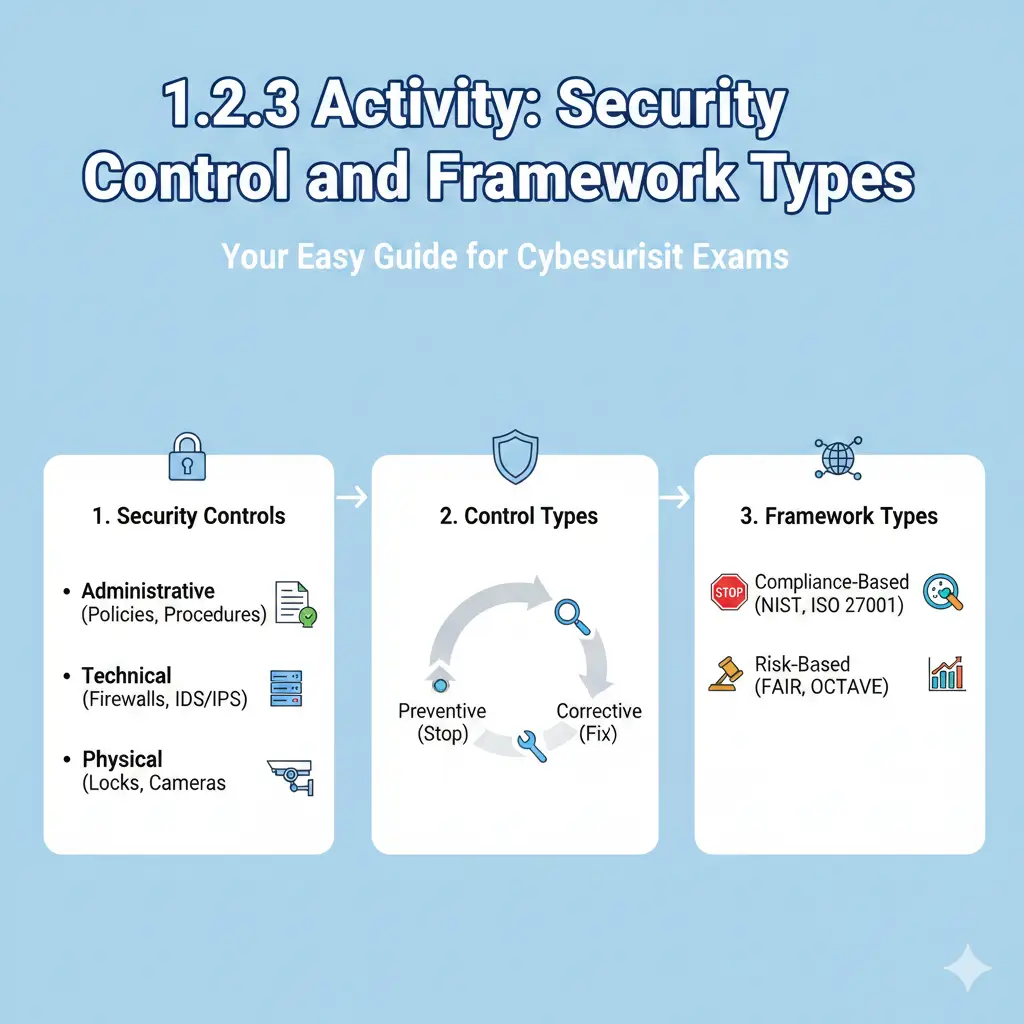
1.2.3 Activity: Security Control and Framework Types – Your Easy Guide for Cybersecurity Exams
If you’re studying for a cybersecurity exam like CompTIA Security+, the 1.2.3 activity: security control and framework types is a key part. This activity helps you learn how to pick the right security controls for real problems. You read a short story about a security issue, then choose the best control category and type to fix it. It’s like a hands-on quiz that tests if you understand types of security controls and how they fit into bigger plans called cybersecurity frameworks. This guide breaks it all down in easy steps, with examples, so you can feel ready and confident.
Why 1.2.3 Activity: Security Control and Framework Types Matters for Your Studies
Many students face performance-based security questions in exams. These are not just multiple-choice. They make you think and apply what you know. The 1.2.3 activity: security control and framework types is one of these. It comes from study tools like flashcards and interactive questions. You get a scenario, like “Employees click bad links too often,” and you pick the right fix.
This builds skills for real jobs too. Early-career IT/cybersecurity professionals use these ideas every day. Security controls are tools or rules that protect data and systems. They stop attacks, spot them, or fix damage. Knowing security control categories helps you group them: some use tech, some are rules, some are locks and guards.
Big plans called security control frameworks guide companies. They show how to use controls step by step. Popular ones include the NIST cybersecurity framework, ISO 27001 controls, and CIS controls. These help with security controls for compliance and security controls best practices.
For cybersecurity certification study, this topic is in CompTIA Security+ SY0-701 Domain 1. It covers about 12% of the exam. Mastering it helps with security controls assessment and control implementation in cybersecurity.
Breaking Down Security Control Categories
Security controls fall into groups based on how they work or what they protect. CompTIA and experts use these main security control categories:
- Technical security controls: These use tech like software and hardware. They are automatic.
- Administrative security controls: These are rules, policies, and training. People follow them.
- Physical security controls: These stop bad people from touching things, like locks or cameras.
- Managerial security controls: These are big-picture plans from leaders, like risk checks.
- Operational security controls: These are day-to-day actions by people, like backups.
Some sources group them as technical, administrative, and physical. Others add managerial and operational.
Here are easy security control examples for each:
| Category | What It Does | Examples |
| Technical security controls | Use tools to block or watch threats | Firewalls, antivirus, encryption |
| Administrative security controls | Set rules and teach people | Policies, training, background checks |
| Physical security controls | Protect places and things | Locks, guards, badges, cameras |
| Managerial security controls | Plan and oversee security | Risk assessments, audits |
| Operational security controls | Daily tasks to keep things safe | Monitoring logs, incident response |
Mix these for strong protection. This is called defense in depth.
Understanding Types of Security Controls
Controls also group by what they do in an attack. Here are the main types of security controls:
- Preventive security controls: Stop bad things before they happen.
- Examples: Firewalls, training, locks, access lists.
- Detective security controls: Spot bad things when they start or after.
- Examples: Logs, alarms, cameras, intrusion detection systems (IDS).
- Corrective security controls: Fix problems after they happen.
- Examples: Backups, patches, incident plans.
- Deterrent security controls: Scare people away from trying bad things.
- Examples: Warning signs, guards, fake cameras.
- Compensating security controls: Use these when the best one isn’t possible.
- Examples: Extra checks if no full encryption.
Some add risk management controls for overall planning.
These types work together. Preventive is the first line. The detective catches what gets through. Corrective cleans up.
Practice with Performance-Based Security Questions
In the 1.2.3 activity: security control and framework types, you see scenarios like these:
- The IT admin says: “We need to spot bad network activity fast.” → Pick detective, maybe monitoring, like IDS.
- The CEO says: “Employees visit bad sites. Do we have rules?” → Pick preventive policy types, like acceptable use policy.
- CIO says: “Anyone can enter the server room.” → Pick physical, access control, like locks or badges.
Practice these for exams. They test if you can match issues to controls.
Tip: Think “What stops it? What finds it? What fixes it?”
Key Cybersecurity Frameworks and Security Management Frameworks
Security control frameworks are big guides. They help build full programs. Here are top ones:
NIST Cybersecurity Framework
This free guide from the US government is popular. It has six main parts (in version 2.0):
- Govern: Set rules and watch risks.
- Identify: Find what to protect.
- Protect: Use safeguards.
- Detect: Spot issues.
- Respond: Handle attacks.
- Recover: Get back to normal.
It’s flexible for any size business. Great for risk management controls.
ISO 27001 Controls
This international standard has 93 controls in four groups1:
- Organizational (policies, roles).
- People (training, awareness).
- Physical (locks, secure areas).
- Technological (tech tools).
You get certified if you follow it. Good for security controls for compliance.
CIS Controls
Version 8 has 18 main controls, with steps for small to big groups. Starts with basics like inventory and access.
Prioritizes what stops real attacks most.
Other frameworks map to these, like COBIT for management.
Use them for security policy frameworks and information security controls.
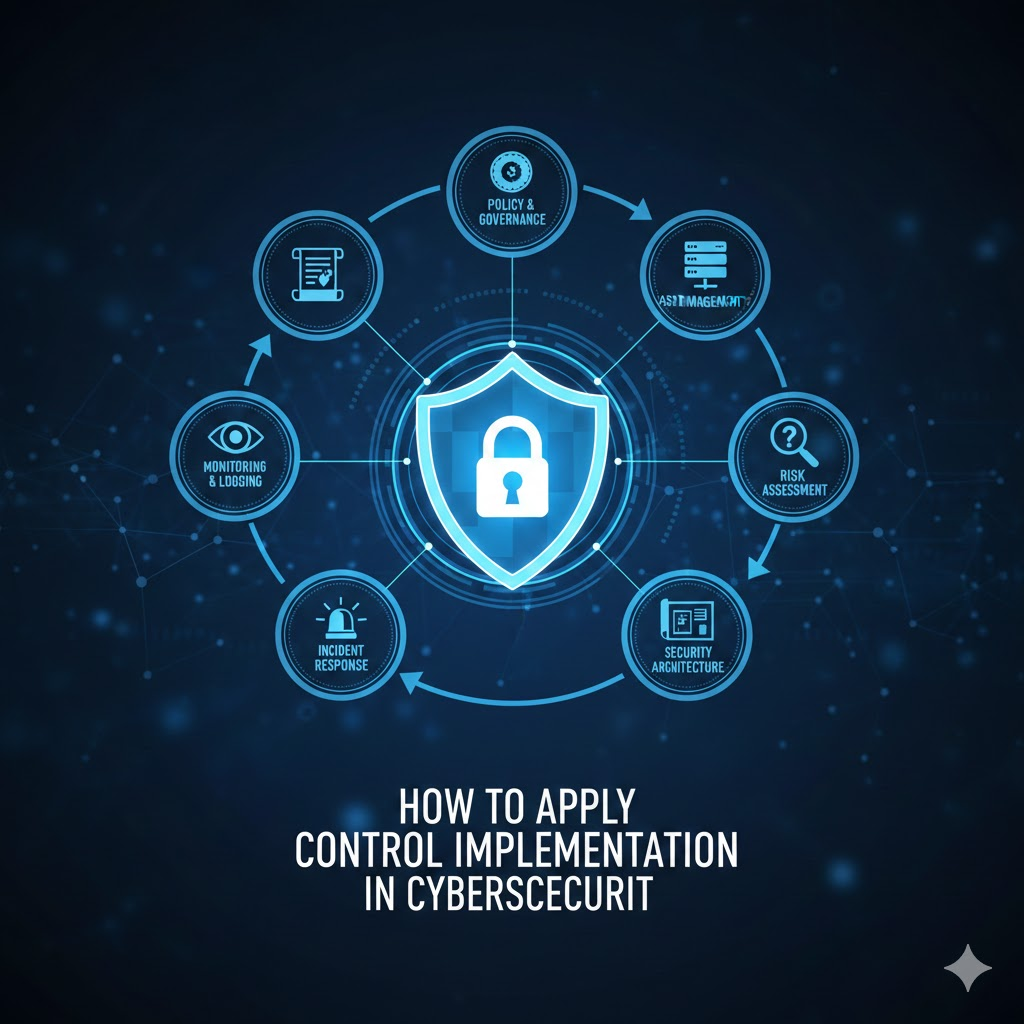
How to Apply Control Implementation in Cybersecurity
Follow these steps:
- Find risks (use Identify in NIST).
- Pick controls from categories and types.
- Put them in place (technical like firewalls, administrative like policies2).
- Check they work (security controls assessment).
- Fix and improve.
Security controls best practices:
- Layer them (many types together).
- Train everyone.
- Update often.
- Test with audits or pen tests.
For exams, remember examples and scenarios.
Real-World Security Control Examples
- A company uses firewalls (preventive, technical) and training (preventive, administrative).
- Banks use cameras (detective, physical) and backups (corrective).
- Small businesses start with CIS controls basics.
Over 90% of attacks hit weak basics, so good controls stop most.
Tips for Your Cybersecurity Certification Study
- Use flashcards for categories and types.
- Practice PBQs with scenarios.
- Map controls to frameworks.
- Quiz yourself: “Is this preventive or detective?”
You got this! These ideas help in exams and jobs.
In Conclusion: Master 1.2.3 Activity: Security Control and Framework Types
The 1.2.3 activity: security control and framework types ties everything together. It shows how security controls in categories like technical security controls, administrative security controls, and physical security controls work with types such as preventive security controls, detective security controls, and corrective security controls. Frameworks like the NIST cybersecurity framework, ISO 27001 controls, and CIS controls give the big plan. This keeps systems safe, meets rules, and stops threats.
Study these, practice scenarios, and you’ll ace your exam. What framework do you want to try first in a real job?
For more practice, check these:
Frequently Asked Questions About 1.2.3 Activity: Security Control and Framework Types
What is 1.2.3 activity: security control and framework types?
It is a study exercise. You read a problem and pick the best security control to fix it. It tests control categories and types.
What are the main types of security controls?
They are preventive (stop attacks), detective (find attacks), corrective (fix attacks), deterrent (scare attackers), and compensating (backup options).
What are security control categories?
Main ones are technical (tools), administrative (rules), physical (locks), managerial (plans), and operational (daily tasks).
Name some security control examples.
Firewalls (preventive, technical), training (preventive, administrative), cameras (detective, physical).
What is the NIST cybersecurity framework?
A guide with six steps: Govern, Identify, Protect, Detect, Respond, Recover. It helps manage risks.
Why learn cybersecurity frameworks?
They give a full plan for using controls. Good for exams and real security jobs.
How do ISO 27001 controls work?
They have 93 rules in groups like people and tech. Companies get certified.
What are CIS controls?
18 key steps to stop common attacks. Starts simple for small teams.
Are security controls needed for compliance?
Yes. Many laws require them. Frameworks help meet rules.
References
- Quizlet Flashcards (2023): Flashcards on security controls.Definitions of control categories (operational, technical, managerial) and types (preventive, detective, etc.). Targeted at students preparing for CompTIA Security+ exams with memorization aids. ↩︎
- PurpleSec Article (Updated 2024): Detailed explanations of controls. Practical explanations of functional types and categories (technical, administrative, physical) with business examples. Aimed at entry-level professionals and managers needing accessible overviews. ↩︎
