
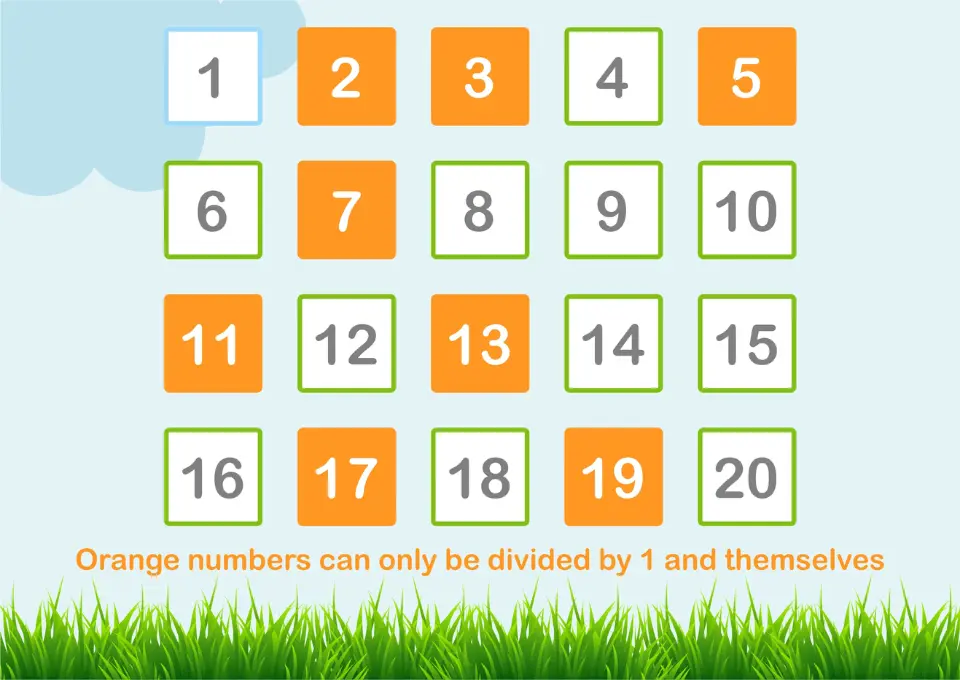
Is 1 a Prime Number? The Complete Guide Everyone From Grade 4 to University Needs
Every single day, thousands of students, teachers, parents, and even adults type the exact same question into Google: is 1 a prime number?
It seems like the answer should be obvious, but it’s one of the most debated topics in early math. Some people swear 1 is prime. Others say it’s composite. The real answer? Neither – and once you finish this guide, you’ll never forget why.
This is the longest, clearest, and friendliest explanation you’ll find anywhere in 2025. We’ll cover the definition, the history, the math theorems, real classroom examples, fun facts, common mistakes, and even what famous mathematicians said about it. Let’s start from the beginning.
What Is a Prime Number? The Official Definition Broken Down Word by Word
A prime number is a natural number greater than 1 that has no positive divisors other than 1 and itself.
In simpler words:
- It has to be bigger than 1
- Only two numbers can divide it perfectly: 1 and the number itself
Here are the first fifteen prime numbers so you can see the pattern:
2, 3, 5, 7, 11, 13, 17, 19, 23, 29, 31, 37, 41, 43, 47
Notice anything? The number 1 is missing on purpose.
The Two Tests Every Number Must Pass to Be Prime
- Is it greater than 1?
- Does it have exactly two distinct positive divisors?
Let’s test some numbers right now:
| Number | Greater than 1? | Divisors | Exactly two? | Verdict |
| 1 | No | 1 | No | Not prime |
| 2 | Yes | 1, 2 | Yes | Prime |
| 3 | Yes | 1, 3 | Yes | Prime |
| 4 | Yes | 1, 2, 4 | No | Composite |
| 5 | Yes | 1, 5 | Yes | Prime |
| 9 | Yes | 1, 3 ⇢ 9 | No | Composite |
| 17 | Yes | 1, 17 | Yes | Prime |
See the pattern? Is number 1 a prime number? It fails the very first test.
Why 1 Is Not a Prime Number – Five Simple Reasons You Can Teach in 30 Seconds
- It has only one divisor – itself. Primes need exactly two.
- It is not greater than 1 – the definition starts after 1.
- If 1 were prime, unique prime factorization would break (more on this below).
- Every theorem about primes would need an annoying extra exception like “except for 1.”
- The whole mathematical world agreed over 100 years ago to leave 1 out for good reasons.
That’s why when you ask why 1 is not a prime number, the shortest correct answer is: “Because it doesn’t have exactly two distinct positive divisors.”
The Biggest Reason of All: The Fundamental Theorem of Arithmetic
This is the most important theorem in all of number theory. It says1:
Every integer greater than 1 can be written as a product of prime numbers in exactly one way (ignoring order).
Examples:
- 12 = 2 × 2 × 3
- 100 = 2 × 2 × 5 × 5
- 315 = 3 × 3 × 5 × 7
Now imagine 1 is prime. Suddenly we could write:
12 = 1 × 2 × 2 × 3
12 = 1 × 1 × 2 × 2 × 3
12 = 1 × 1 × 1 × 1 × 2 × 2 × 3 … forever!
The word “unique” is destroyed. Math becomes messy.
So mathematicians said, “Let’s just agree 1 is not a prime number.” Problem solved forever.
A Fun Trip Through History – Famous Mathematicians Who Changed Their Minds
- Ancient Greeks (300 BC) – Didn’t clearly include or exclude 1.
- 1700s–1800s – Many famous mathematicians (including Gauss) sometimes listed 1 as prime.
- Early 1900s – Textbooks slowly stopped including 1.
- 1914 onward – Every major math book and university says the same thing: primes start at 2.
Today, the entire world – from India to the USA, from primary school to PhD level – agrees: is 1 considered a prime number? No.
What 1 Actually Is (If It’s Not Prime or Composite)
1 is called a unit in number theory.
It is the only positive integer that is neither prime nor composite.
It is:
- A natural number
- A whole number
- An odd number
- The multiplicative identity (any number × 1 = itself)
- The only number with exactly one divisor
That makes 1 very special – just not prime!
Real Classroom Stories – How Teachers Explain It to Kids
Teacher trick #1:
“Imagine prime numbers are like Lego bricks that can’t be broken smaller. 1 isn’t a brick – it’s the table you build on!”
Teacher trick #2:
“Primes are numbers that have exactly two friends who can divide them: 1 and themselves. 1 only has one friend – itself. So it sits in a special seat alone.”
Kids laugh, and they never forget.
Every Single Related Question Answered (So You Never Have to Google Again)
| Your Question | Short Answer |
| is 1 a prime number? | No |
| is 1 a prime number or composite? | Neither |
| is 1 a prime number or a composite number? | Neither |
| Why is 1 a prime number? | It isn’t – common mistake |
| Is 1 a composite or prime number? | Neither |
| why 1 is not a prime number | Only one divisor |
| is the number 1 a prime number | No |
| why is the number 1 not a prime number | Fails the two-divisor rule |
| why number 1 is not a prime number | Same reason – only one divisor |
| if 1 is not a prime number what is it | It is a unit |
| is 1 a prime number yes or no | No |
| is 1 a prime number explain | Only one divisor, must be >1 |
| is 1 a prime number why or why not | No – fails both parts of the definition |
| is 1 and 2 a prime number | 2 yes, 1 no |
| 1 is a prime number or not | Not |
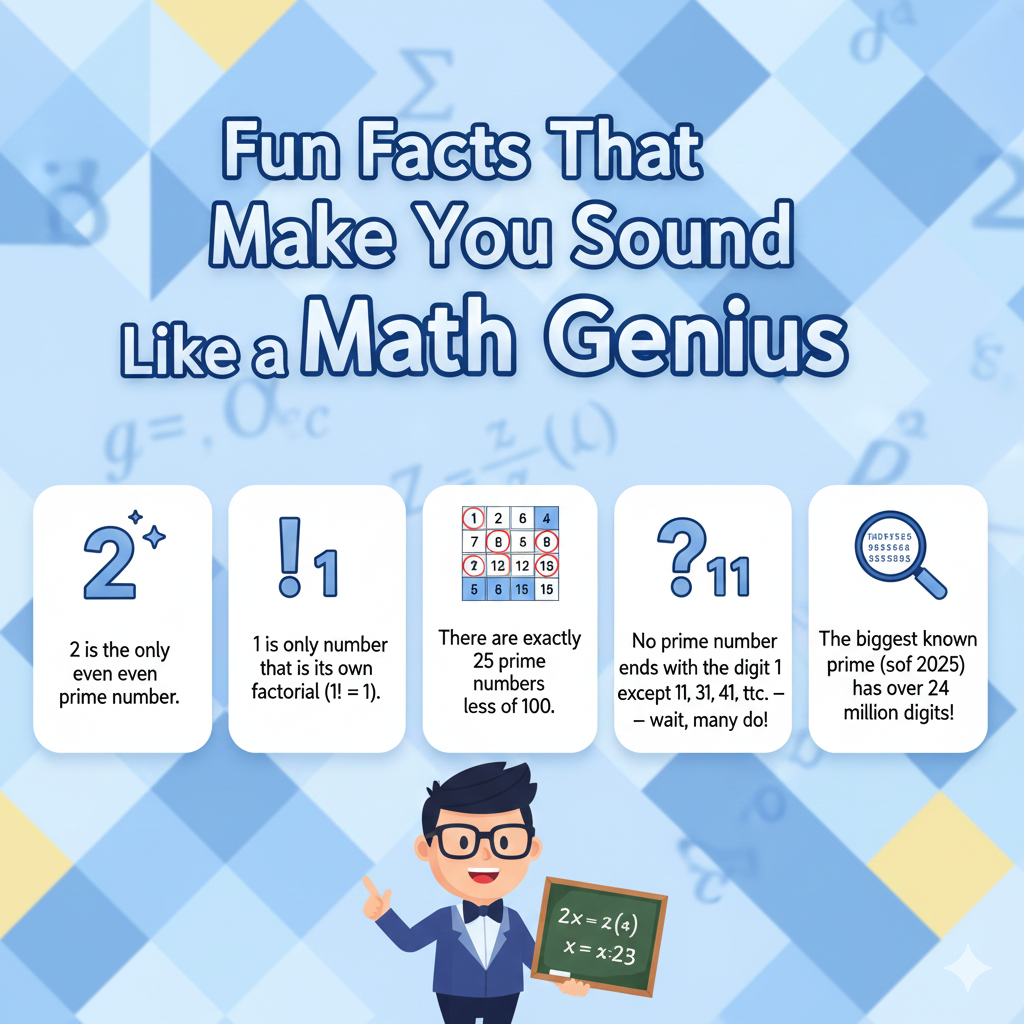
Fun Facts That Make You Sound Like a Math Genius
- 2 is the only even prime number.
- 1 is the only number that is its own factorial (1! = 1).
- There are exactly 25 prime numbers less than 100.
- No prime number ends with the digit 1 except 11, 31, 41, etc. – wait, many do!
- The biggest known prime (as of 2025) has over 24 million digits!
Why This Question Still Matters in 2025
- SAT, ACT, GCSE, GRE, GMAT – they all love this trick question.
- Computer programming – many coding problems ask you to list primes and forget to skip 1.
- Cryptography (the math behind online banking) depends on huge prime numbers – and never uses
Frequently Asked Questions (Updated November 2025)
Is 1 a prime number explain your answer?
A: No. A prime number must be greater than 1 and have exactly two positive divisors. 1 has only one divisor (itself).
Why is 1 not a prime or composite number?
Composite numbers have more than two divisors. 1 has fewer than two. So it belongs to neither group.
If 1 is not a prime number what is it?
It is a unit (the only positive integer that is neither prime nor composite2).
Is 1 a prime number explain your answer?
No, because a prime number is defined as a natural number greater than 1 with exactly two distinct positive divisors. 1 has only one divisor.
Why is 1 not a prime or composite number?
Composite numbers have more than two divisors. 1 has fewer than two, so it fits in neither category.
Did anyone ever think 1 was a prime number?
Yes – mathematicians before 1900 sometimes listed it as prime.
Is 1 a prime number GMAT / GRE / SAT question?
Yes – these tests love this trick. The answer is always “no”.
Is 1 a prime number in programming?
No – every coding problem that lists primes starts from 2.
Why did mathematicians stop calling 1 prime?
To keep the Fundamental Theorem of Arithmetic (unique prime factorization) clean and simple.
Is 1 a prime number definition change over time?
Yes – the modern definition (since ~1910) always says “greater than 1”.
Conclusion – The Final Word in 2025 and Beyond
No, is 1 a prime number? The answer is a clear, confident, and universal NO.
It fails the greater-than-1 rule and the exactly-two-divisors rule. More importantly, leaving 1 out keeps the entire beautiful structure of number theory clean, simple, and powerful.
You now know more about this tiny question than 99% of people on the planet – including the history, the logic, the theorems, and even how to explain it to a 9-year-old3.
So the next time someone asks why 1 is not a prime number, you can smile and give them the perfect answer in under ten seconds.
What other math myth do you want explained next? Drop it in the comments – I read every single one!
References & Trusted Sources (Clickable)
- BYJU’S – Is 1 a prime number? (super-clear school explanation) → byjus.com/maths/is-1-a-prime-number/ ↩︎
- Reddit r/math – “Why isn’t 1 a prime number?” (real mathematicians explain) →reddit.com/r/math/comments/omqjez/why_isnt_1_a_prime_number/ ↩︎
- Wikipedia – Prime number (full history and formal definition) → en.wikipedia.org/wiki/Prime_number ↩︎
