

Spring Boot Tricky Interview Questions for 10 Years Experience
If you have worked as a Java developer for 8 to 12 years, you are already very skilled. When you try for big jobs like Lead or Architect, the interview becomes much harder. The people asking questions do not want simple answers anymore. They ask deep and tricky questions about Spring Boot to see how well you really understand it after many years of work.
These tough Spring Boot questions are made for people who have about 10 years or more of experience. The interviewers want to know if you understand what happens inside Spring Boot. They also want to hear about real problems you have solved when apps run in big companies. Things like slow performance, hard bugs, or building systems with many small parts that work together are common topics.
This guide is here to help you get ready for those hard Spring Boot interviews. This guide shows you real-life problems that senior developers often meet at work. It asks questions about what you would do in those situations. We talk about the hard parts in very simple ways. We explain things that can go wrong when Spring Boot sets itself up automatically. We also show how to build your own special monitoring tools with Actuator. You will learn clever ways to use caching so your app runs much faster. We cover safe and smart ways to add security to protect your app. Finally, we explain how to plan and build microservices the right way so everything works well when the app is live and many people are using it. These are the tricky topics that help you show you are ready for big roles. Practicing these will make you feel strong and ready for your next big interview.
Understanding Spring Boot tricky interview questions for 10 years experience
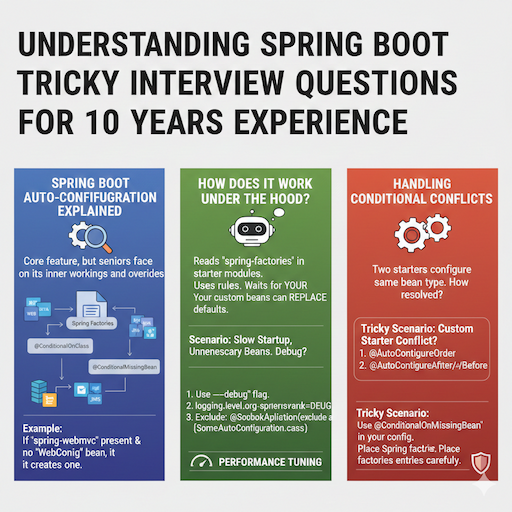
Spring Boot auto configuration explained is a core feature, but seniors face questions on its inner workings and overrides.
How Does Spring Boot Auto-Configuration Work Under the Hood?
Spring Boot auto-configuration is like a smart helper. It looks at all the files and tools in your project. It reads special setup files called spring factories in starter modules to know what to do.
It uses easy rules like @ConditionalOnClass, @ConditionalOnMissingBean, and @ConditionalOnProperty. These rules help it decide when to make new parts called beans.
For example, if you have the spring-webmvc tool and no special web starter bean, it makes one for you.
The tricky part is this: Auto-configuration waits until after your own beans are ready. So, your custom beans can change or replace the ones Spring Boot made by default.
Scenario: Your app starts slowly with many unnecessary beans. How do you debug?
Use –debug flag or logging.level.org.springframework=DEBUG to see auto-configuration report. Exclude unwanted auto-configs with @SpringBootApplication(exclude = {SomeAutoConfiguration.class}).
This relates to Spring Boot internal working and helps in Spring Boot performance tuning.
Handling Conditional Conflicts in Auto-Configuration
Imagine two starters both trying to configure the same bean type. How does Spring resolve this?
Spring Boot orders auto-configurations via @AutoConfigureOrder or @AutoConfigureAfter/Before.
Tricky scenario: You add a custom starter, but it conflicts with built-in ones.
Solution: Use @ConditionalOnMissingBean in your config and place your Spring factories entries carefully.
Advanced Dependency Injection and Bean Lifecycle Tricks
Spring Boot dependency injection lifecycle questions test how well you handle complex bean management.
Resolving Circular Dependencies in Spring Boot
Circular dependencies occur when Bean A needs Bean B, and vice versa.
Spring handles constructor injection circles by throwing BeanCurrentlyInCreationException, but allows setter/field injection via proxies.
Tricky question: How to fix circular dependency in constructor injection?
Use @Lazy on one injection point, or refactor to an event-based design.
In production, this can cause startup failures, common in Spring Boot production issues.
Customizing Bean Scopes in High-Concurrency Scenarios
Default scope is singleton, but for request/session scopes in microservices?
Use @Scope(“prototype”) or proxyMode = ScopedProxyMode.TARGET_CLASS for injected proxies.
Scenario-based: In a clustered environment, session scope doesn’t replicate. Switch to a distributed session with Redis.
This ties into Spring Boot concurrency interview questions. 30 Advanced Spring Boot Interview Questions for Experienced Professionals1
Spring Boot Tricky Interview Questions for 10 Years Experience: Microservices Edition
Spring Boot microservices interview questions dominate senior interviews.
Designing Resilient Microservices with Circuit Breakers
How do you prevent cascading failures?
Use Resilience4j or Spring Cloud Circuit Breaker.
Annotate methods with @CircuitBreaker, @Retry, and @Bulkhead.
Tricky scenario: High traffic causes one service slowdown, affecting others.
Implement fallback methods and monitor with Actuator/Micrometer.
Handling Distributed Transactions in Microservices
Traditional @Transactional doesn’t span services.
Use Saga pattern: Orchestration (central coordinator) or Choreography (event-driven).
Tools: Spring Cloud with Kafka/RabbitMQ for events.
Real-time question: Compensating transactions for rollback in eventual consistency.
Example: Order service publishes OrderCreated; Payment service consumes and publishes PaymentProcessed or Failed.
This is key for Spring Boot architecture interview questions.
Performance Tuning and Optimization Challenges
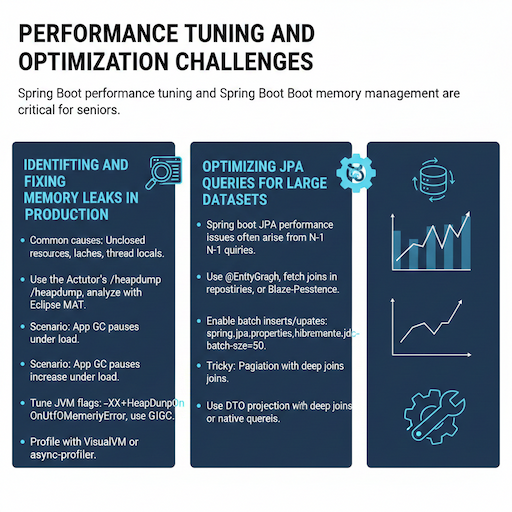
Spring Boot performance tuning and Spring Boot memory management are critical for seniors.
Identifying and Fixing Memory Leaks in Production
Common causes: Unclosed resources, large caches, thread locals.
Use the Actuator’s /heapdump, analyze with Eclipse MAT.
Scenario: App GC pauses increase under load.
Tune JVM flags: -XX:+HeapDumpOnOutOfMemoryError, use G1GC.
Profile with VisualVM or async-profiler.
Optimizing JPA Queries for Large Datasets
Spring Boot JPA performance issues often arise from N+1 queries.
Use @EntityGraph, fetch joins in repositories, or Blaze-Persistence.
Enable batch inserts/updates: spring.jpa.properties.hibernate.jdbc.batch_size=50.
Tricky: Pagination with deep joins.
Use DTO projections or native queries.
Security Deep Dive: Tricky Implementation Questions
Spring Boot security interview questions focus on production-grade setups.
Implementing OAuth2 with JWT in Microservices
Use spring-boot-starter-oauth2-resource-server.
Configure jwt.decoder() with JWK set URL.
Scenario: Token validation fails intermittently.
Check clock skew with spring.security.oauth2.resourceserver.jwt.clock-skew=5s.
Secure Actuator endpoints separately.
Handling CSRF and CORS in APIs
Stateless APIs disable CSRF: http.csrf().disable().
For CORS: @CrossOrigin or global config.
Tricky: Frontend on a different domain, pre-flight fails.
Allow specific methods/headers in CorsConfiguration.
Advanced Spring Boot Interview Questions: Actuator and Monitoring
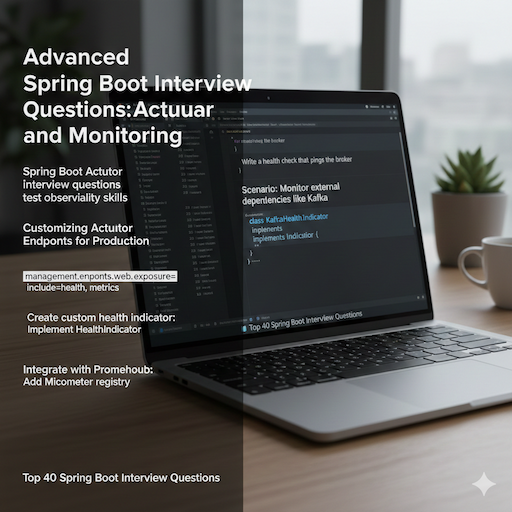
Spring Boot Actuator interview questions test observability skills.
Customizing Actuator Endpoints for Production
Expose only needed: management.endpoints.web.exposure.include=health, metrics.
Create custom health indicator: Implement HealthIndicator.
Scenario: Monitor external dependencies like Kafka.
Write a health check that pings the broker.
Integrate with Prometheus: Add Micrometer registry. Top 40 Spring Boot Interview Questions2
Caching Strategies and Pitfalls
Spring boot caching strategies question probe distributed caching.
Implementing Distributed Caching with Redis
Use spring-boot-starter-data-redis, @EnableCaching.
Annotate methods with @Cacheable(cacheNames=”users”, key=”#id”).
Tricky: Cache stampede on expiration.
Use Caffeine as L1 + Redis L2, or @Cacheable(sync=true).
Handle eviction policies: TTL with @CacheEvict.
Exception Handling Best Practices
Spring boot exception handling best practices for clean APIs.
Global Exception Handling with @ControllerAdvice
Create a class with @ExceptionHandler.
Return a ResponseEntity with an error DTO.
Scenario: Different errors for dev/prod.
Use profiles to log stack traces only in dev.
Logging and Troubleshooting in Production
Spring boot logging framework defaults to Logback.
Customize with logback-spring.xml.
Real-time: Correlate logs across microservices.
Use MDC with trace IDs from Sleuth/Micrometer Tracing.
Spring Boot Annotations Deep Dive
Spring boot annotations deep dive covers nuances.
Differences Between @Component, @Service, @Repository
All register beans, but @Repository adds translation for persistence exceptions.
Tricky: @Service in transaction advice.
No semantic difference, but aids readability and AOP pointcuts.
Scenario-Based Questions for Lead Developers
Spring boot interview questions for lead developer often involve architecture.
Migrating Monolith to Microservices
Identify bounded contexts (DDD).
Strangler pattern: Gradually replace parts.
Challenges: Data consistency, service communication.
Troubleshooting Slow Startup in Large Apps
Too many beans or scans.
Use @ComponentScan filters, lazy init: spring. main.lazy-initialization=true (careful with side effects). Advanced Spring Boot Interview Questions for Experienced Developers3
FAQs
How to create custom Spring Boot starter modules?
A custom Spring Boot starter is like your own helper package that adds features easily. You make a special setup class with @Configuration and @ConfigurationProperties to control settings. Then, you put the name of your setup class in a file called spring.factories so Spring Boot finds it and uses it automatically.
Handling file uploads in REST APIs with best practices?
To let people upload files, use MultipartFile in your controller method. Always check the file size and type first to keep your app safe. Then send the file to storage (like a folder or cloud) by reading it as a stream so it does not use too much memory.
Integrating Kafka for event-driven architecture?
Kafka helps your app send and receive messages fast, like notes between friends. Use spring-kafka in your project and add @KafkaListener on a method to get messages easily. To stop the same message from being used twice, add special numbers or IDs in the message headers so your app knows it already saw it.
Conclusion
You should study hard questions and answers for senior developers. Look at real-life situation questions (called scenario-based questions) with good answers too.
These questions are for people who know a lot about Spring Boot. They ask deep questions about how Spring Boot really works inside. They want to know how to build microservices the correct and smart way. They also check if you can make apps run fast and stay strong when many people use them in real companies. Practice these hard senior Spring Boot questions a lot. When you know them well, you can prove you are ready for big, important jobs and be better than the others!
What is the toughest Spring Boot challenge you have faced in production? Share in comments to help others prepare.
